For PRO users it opens straight in the simulator. Not PRO yet? All about PRO, and meanwhile 9 scenarios are free for everyone. The PRO app interface is in Hebrew.
The mission
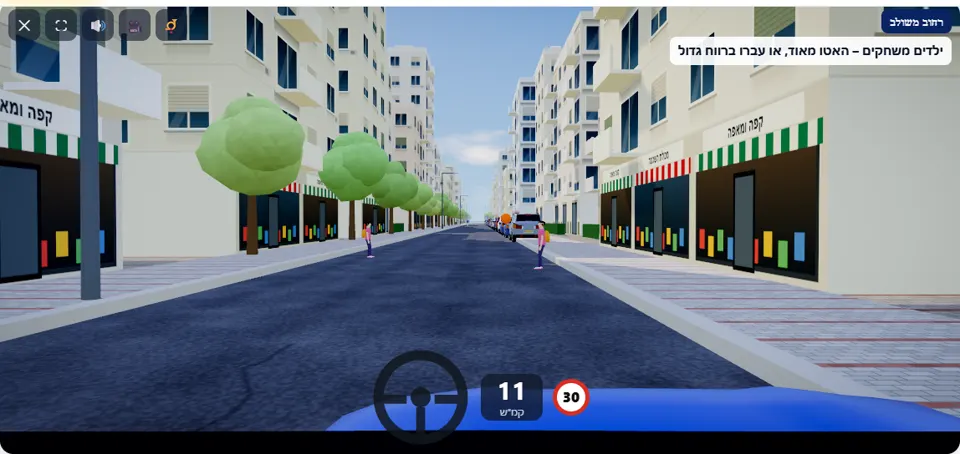
You have entered a shared street (sign 220): the road is also used for children’s games and by pedestrians. Drive slowly – no more than 30 km/h – and let the children and the pedestrians carry on with what they are doing. A child in the way? Slow down or stop, and drive on only when it is clear that your driving does not endanger the child.
At the entrance to the street stands sign 220, “Shared street” (the official English questions call it a “play street”), and at its end sign 221. There are no lane markings here: cars are parked along the right-hand edge, and in the road itself there are people – two children throwing a ball to each other, one near each side of the street, and an adult walking down the street towards you.
Further on a van is parked, and behind it a child is hidden. As you approach, the child steps into the road, and the simulator announces “🚸 A child is stepping out from behind a parked vehicle!”. The child steps out when you have about a second and a half of driving left to reach them, and no less than eight metres – a driver who is going slowly manages to stop.
How to pass the scenario
- From the sign onwards keep your speed low. Above about 32 km/h for more than two seconds the drive is failed (a game threshold).
- Next to the children playing and beside the adult walking towards you, slow right down. You may use the whole width of the street, and when there is room – pass them with a wide side gap.
- Have to pass close, less than about a metre? Only at walking pace – up to about 10 km/h (a game threshold).
- When the child steps out from behind the parked van – stop, and drive on only after the child has crossed to the other side.
Mistakes that fail you
Each of these mistakes ends the drive at once, with the message quoted next to it:
- Driving fast after sign 220. The simulator: “You drove above 30 km/h in a shared street.”
- Passing close, and faster than walking pace, by a child or a pedestrian in the road. The simulator: “You passed too close and too fast to someone in the road – in a shared street, drive on only when it is clear that your driving does not endanger them.”
- Not stopping for the child who steps out from behind the parked van. The simulator: “You hit a child in the shared street.”
- Hitting the adult walking in the road. The simulator: “You hit a pedestrian who was walking in the road.”
- Driving right up against the row of parked cars. The simulator: “You hit a parked car – keep away from the roadside.”
Three possible warnings: “More slowly near the children” – above about 20 km/h at less than two and a half metres from a child; sounding the horn near the children (“The horn does not clear the way – in a shared street you let the children carry on playing”); and the speed warning. A slow drive without the horn ends with three stars.
The speeds, distances and seconds the simulator checks are game thresholds, not numbers from the law – unless they appear in the rule itself.
Keys and buttons in this scenario
Accelerator, brake and steering – you may drive across the whole width of the street in order to pass the children with a gap. The horn (the B key or the 📯 button) works, but here it costs you a warning.
In all scenarios: on a computer – arrows or WASD to accelerate and steer, and Space to brake; on a phone – accelerator, brake and steering buttons on the screen. The C key or the 🎥 button switches between the driver’s seat and a view from behind the car, the B key or the 📯 button sounds the horn, and the 🔊 button mutes the sound.
The official theory questions on this situation
The scenario is built on 4 questions from the official Ministry of Transport bank. Each question has its own page, with all the answers:
- 78 How should one drive while inside a “play street”?
Correct answer: The driver should allow pedestrians and children to carry on with their activities without endangering them
- 154
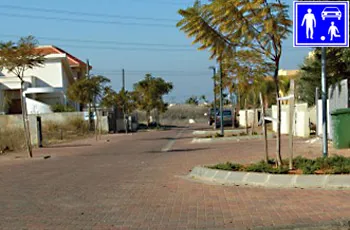 What is the maximum allowed speed in a “play street”?
Correct answer: 30 KPH.
- 34 Define “play street”:
Correct answer: A road designed for children’s games, pedestrians and vehicles, sign posted at the entrance with the “play street” sign.
- 908
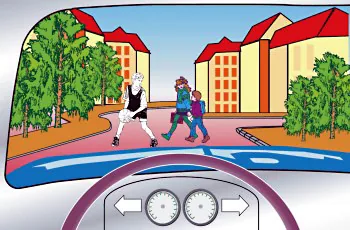 Describe the following situation:
Correct answer: Children playing on the road. I will take every necessary precaution so as not to endanger them.
Where to go next
- Drive the “Shared street” scenario in the simulator (opens for PRO users)
- All 32 scenarios of the driving simulator
- Test yourself: mock theory exam in English
Related scenarios
FAQ about the “Shared street” scenario
What is the speed limit in a shared street?
Children are playing in the road – do you have to wait for them to move?
May you sound the horn so that the children make room?
Sources: Traffic Regulations (Hebrew) · theory question bank on data.gov.il. The simulator is a tool for practising the rules only and does not replace driving lessons with a licensed instructor.