Free for everyone – no sign-up and nothing to install, on a computer or a phone.
The mission
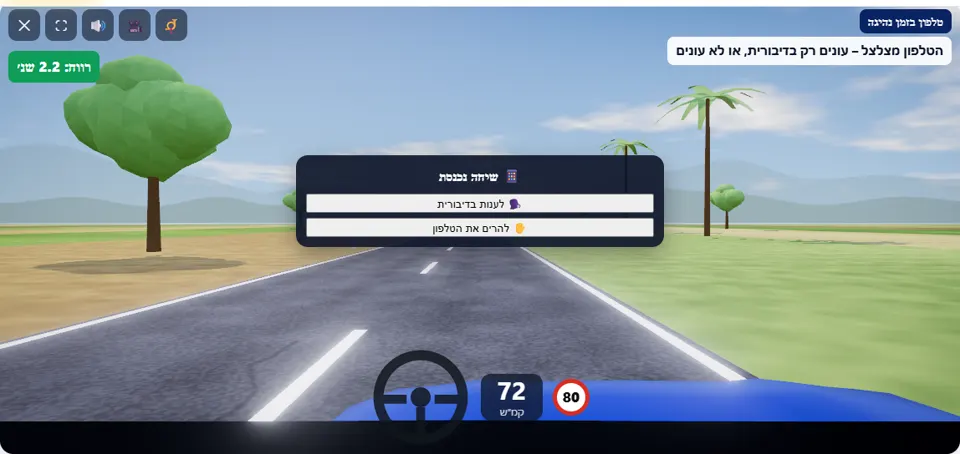
You are driving on an interurban road, and the phone in its holder rings and then receives a message. Do not hold the phone and do not read the message. You may answer the call only hands-free, without holding the phone – and keep your eyes on the road: the car in front may brake at any moment.
An interurban road, 80 km/h, and a car driving ahead of you that brakes hard twice, at moments you cannot guess in advance. After about six seconds the phone rings: on the screen appear “📱 Incoming call” and two buttons – “🗣️ Answer hands-free” and “✋ Pick up the phone”. You have seven seconds to decide, and not answering at all is a valid choice too.
Later comes “💬 New text message (SMS)”, with “Read now” or “Later”. Whoever picks up the phone or reads the message sees the road disappear for two seconds, while the car keeps driving – and then the drive is failed, with the number of metres you covered without seeing. The two seconds are a value set by the game; the metres are simply speed multiplied by time.
How to pass the scenario
- From the start keep a gap of at least 2 seconds from the car in front. Below 2 seconds a warning appears.
- When the phone rings – answer hands-free, or simply do not answer. Whoever answers in the middle of braking gets a reminder that the call can wait.
- When the text message arrives – choose “Later”.
- Eyes on the car in front: when its brake lights come on – brake at once.
- Carry on like this until the end of the drive, after about 45 seconds.
Mistakes that fail you
Each of these mistakes ends the drive at once, with the message quoted next to it:
- Picking up the phone (the number in the message is the distance you actually drove; here an example at 80 km/h). The simulator: “You picked up the phone while driving – you may use it only hands-free, without holding it. While you were looking at it you drove about 44 metres without seeing the road.”
- Reading the text message. The simulator: “You read a text message while driving – when the vehicle is moving it is forbidden to read or send a text message. While you were looking at it you drove about 44 metres without seeing the road.”
- Driving for about a second and a half in a row at less than a second from the car in front. The simulator: “You drove too close to the car in front (less than one second).”
- Not braking in time when the car in front brakes. The simulator: “You crashed into the car in front – there was no gap left to stop.”
Two possible warnings: “Gap under 2 seconds – increase the distance”, and “The phone rang while you were driving close to the car in front – keep a gap of at least 2 seconds”. The confirmation messages do not cost a star. At the end you are shown how many metres you would have covered in a 2-second look, at the speed at which the phone rang.
The speeds, distances and seconds the simulator checks are game thresholds, not numbers from the law – unless they appear in the rule itself.
Keys and buttons in this scenario
Accelerator and brake. For the call and the text message you choose by clicking the button on the screen, or with the number keys 1 and 2 on a computer. No special steering is needed – you stay in your lane.
In all scenarios: on a computer – arrows or WASD to accelerate and steer, and Space to brake; on a phone – accelerator, brake and steering buttons on the screen. The C key or the 🎥 button switches between the driver’s seat and a view from behind the car, the B key or the 📯 button sounds the horn, and the 🔊 button mutes the sound.
The official theory questions on this situation
The scenario is built on 4 questions from the official Ministry of Transport bank. Each question has its own page, with all the answers:
- 76 How can a cellular phone be operated whilst driving?
Correct answer: Only by means of a “hands free device” that is installed in the vehicle and can be used without being held.
- 399 Is a driver permitted to send an S.M.S message from his phone while driving?
Correct answer: It is absolutely prohibited, and dangerous.
- 75 Is it permitted to take one hand off the wheel or handlebar while driving?
Correct answer: No, except for changing gears and operating the direction indicator, or in order to assure the vehicle's proper function.
- 1064 What is the risk of using the GPS navigation system while driving?
Correct answer: Driver distraction.
Where to go next
Related scenarios
FAQ about the “Phone while driving” scenario
Is it allowed to talk on the phone while driving?
And what about messages?
Where does the number of metres come from?
Sources: Traffic Regulations (Hebrew) · theory question bank on data.gov.il. The simulator is a tool for practising the rules only and does not replace driving lessons with a licensed instructor.