For PRO users it opens straight in the simulator. Not PRO yet? All about PRO, and meanwhile 9 scenarios are free for everyone. The PRO app interface is in Hebrew.
The mission
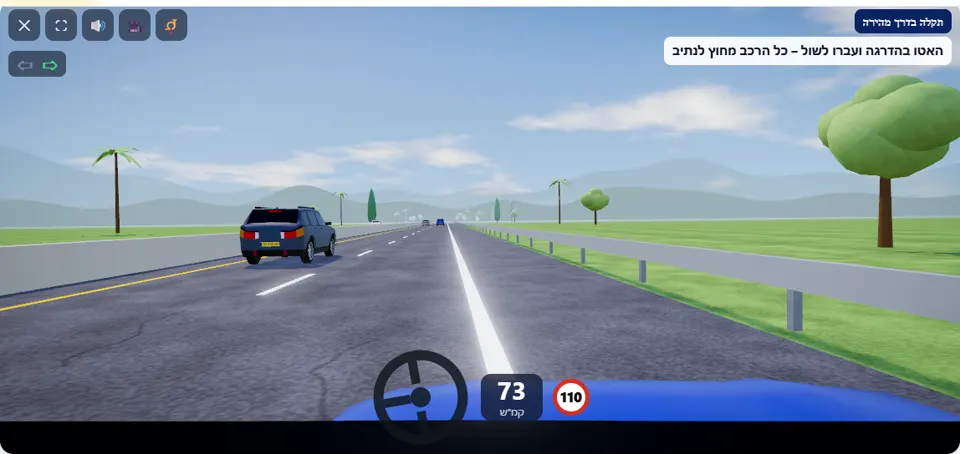
A warning light comes on and the engine loses power in the middle of the freeway. Check your mirrors, signal right (E key or the signal button), slow down gradually and move onto the right-hand hard shoulder – the whole car out of the lane – and stop there. Then choose what to do before you get out of the car.
You are driving in the right-hand lane of a freeway, at about 90 km/h, with a truck behind you and traffic in both lanes. After a few seconds the message “⚠️ Warning light – the engine is losing power!” appears, and from that moment the accelerator pedal does nothing: the car carries on under its own momentum and slowly loses speed. On the right there is a wide hard shoulder, and beyond it a safety barrier.
The mission is to bring the car onto the hard shoulder – all of it out of the lane – and stop there. After the stop three questions appear on the screen, one after another: what you do before opening the door, where you place the warning triangle and where you wait for the recovery service. The order of the answers changes on every drive.
How to pass the scenario
- Do not brake hard while you are still in the lane – there are vehicles behind you. Above about 30 km/h this gets a warning (a game threshold).
- Press E (or ⇨ on a phone) and signal right before the car starts to leave the lane.
- Steer gently to the right onto the hard shoulder, without getting close to the barrier, and let the car slow down.
- Stop when the whole car is on the hard shoulder – the task line changes to “On the hard shoulder ✓ Stop here”.
- Answer the questions by clicking on the answer or with the 1, 2 and 3 keys.
Mistakes that fail you
Each of these mistakes ends the drive at once, with the message quoted next to it:
- Stopping while the centre of the car is still in the traffic lane. The simulator: “You stopped in a traffic lane of a freeway – a broken-down vehicle is driven to the hard shoulder, as long as that is possible.”
- Hitting the barrier to the right of the hard shoulder. The simulator: “You hit the safety barrier on the right.”
- Swerving into a car driving on the freeway. The simulator: “You collided with a car driving on the freeway – merge only at a safe gap.”
- Answering that you get out of the car before putting on a vest. The simulator: “On a non-urban road whoever gets out of the vehicle wears a fluorescent vest – put it on before you get out.”
- Answering that you place the triangle right next to the car or on it. The simulator: “The warning triangle is placed so that a driver coming from behind can see it from at least 100 metres away.”
Three possible warnings: leaving the lane without signalling right, braking hard in the lane and stopping when the car is only partly on the hard shoulder. The tip about the hazard lights does not cost a star, and a wrong answer about where to wait is not a failure – the drive ends in success, with a safety tip.
The speeds, distances and seconds the simulator checks are game thresholds, not numbers from the law – unless they appear in the rule itself.
Keys and buttons in this scenario
The E key (or the ⇨ button on a phone) to signal right, and the right arrow to steer onto the hard shoulder. After the breakdown the accelerator stops working, so what is left is brake and steering.
In all scenarios: on a computer – arrows or WASD to accelerate and steer, and Space to brake; on a phone – accelerator, brake and steering buttons on the screen. The C key or the 🎥 button switches between the driver’s seat and a view from behind the car, the B key or the 📯 button sounds the horn, and the 🔊 button mutes the sound.
The official theory questions on this situation
The scenario is built on 4 questions from the official Ministry of Transport bank. Each question has its own page, with all the answers:
- 198 How would you mark a vehicle that was forced to be left standing in the road?
Correct answer: Place a warning triangle behind the vehicle that can be seen from at least 100mtrs.
- 722 When a vehicle is forced to stop on an inter-urban road and the driver or one of the passengers is about to exit the vehicle:
Correct answer: The first person to get out of the vehicle must wear a standard fluorescent vest when exiting the vehicle or stepping out of it.
- 1398 Is it permitted to stop a vehicle on a freeway?
Correct answer: No, except for stopping on the “hard shoulder” when the vehicle malfunctions and it is impossible to continue driving,
- 831 What are the actions you are required to take, before intentionally pulling onto the “hard shoulder” of a non-urban road?
Correct answer: Good observations mainly to the rear, signaling appropriately and slowing down.
Where to go next
- Drive the “Breakdown on the freeway” scenario in the simulator (opens for PRO users)
- All 32 scenarios of the driving simulator
- Test yourself: mock theory exam in English
Related scenarios
FAQ about the “Breakdown on the freeway” scenario
Do you have to turn on the hazard lights when the car breaks down?
Where do you place the warning triangle?
Who wears the fluorescent vest?
Sources: Traffic Regulations (Hebrew) · theory question bank on data.gov.il. The simulator is a tool for practising the rules only and does not replace driving lessons with a licensed instructor.