For PRO users it opens straight in the simulator. Not PRO yet? All about PRO, and meanwhile 9 scenarios are free for everyone. The PRO app interface is in Hebrew.
The mission
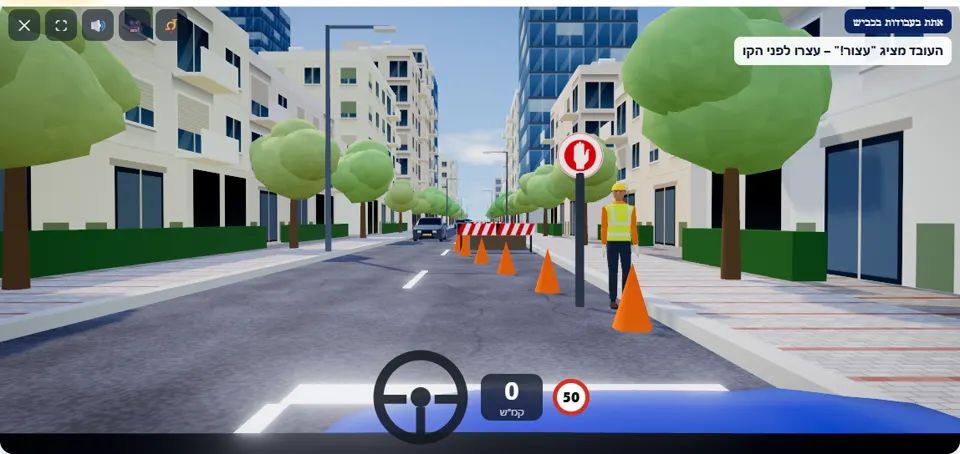
Roadworks close your lane, and at the start of the section stands a worker with a portable sign. When the worker shows you “Stop!” (sign 304) – stop before the section and wait for the vehicles from the opposite direction to pass. Drive on only when the worker turns the sign to “Proceed carefully” (305), and pass the roadworks site slowly.
Roadworks close your lane for about 26 metres: cones, barriers and a trench. Before the site stands sign 901, and a waiting line is marked on the road about 16 metres before the closed section. At the start of the section stands a worker in an orange shirt, a fluorescent vest and a hard hat, holding a pole with a portable sign at its top – and the side facing you is 304, “Stop!”.
Three vehicles from the opposite direction are timed to pass through the open lane exactly as you arrive. Only after they have passed, and after you have stood at the line for a moment, does the worker turn the pole so that 305, “Proceed carefully”, faces you. Then you go round the roadworks on the left, slowly, and return to the right-hand lane.
How to pass the scenario
- Slow down when the roadworks come into view. Above 40 km/h in the last 30 metres before the line the warning “Roadworks – slow down before the section” appears (a game threshold).
- Stop before the waiting line as long as 304 is facing you, even if it looks as if there is room to pass.
- Wait for the oncoming vehicles to pass and for the worker to turn the sign round – a message on the screen confirms when that happens.
- When 305 appears – set off within a few seconds, go round the roadworks on the left at low speed, and return to the right-hand lane after the section.
Mistakes that fail you
Each of these mistakes ends the drive at once, with the message quoted next to it:
- Crossing the waiting line before 305 is facing you. The simulator: “You crossed the waiting line while the worker was showing you “Stop!” – portable sign 304 requires you to stop as long as it is held up in front of you.”
- Not keeping your distance from the worker. The simulator: “You hit the worker at the roadworks site.”
- Not steering round in time and driving into the roadworks. The simulator: “You drove into the roadworks barrier.”
- Drifting into the opposite lane long before the site. The simulator: “You drifted into the opposite lane.”
Three possible warnings: a fast approach to the line, driving at more than about 32 km/h inside the roadworks site (“Drive slowly through the roadworks site”), and standing for more than six seconds after the sign has been turned round (“The worker is letting you proceed – don’t hold up the traffic”).
The speeds, distances and seconds the simulator checks are game thresholds, not numbers from the law – unless they appear in the rule itself.
Keys and buttons in this scenario
Accelerator and brake, the left arrow to go round the roadworks and the right arrow to return to your lane. The signal is not active here.
In all scenarios: on a computer – arrows or WASD to accelerate and steer, and Space to brake; on a phone – accelerator, brake and steering buttons on the screen. The C key or the 🎥 button switches between the driver’s seat and a view from behind the car, the B key or the 📯 button sounds the horn, and the 🔊 button mutes the sound.
The official theory questions on this situation
The scenario is built on 4 questions from the official Ministry of Transport bank. Each question has its own page, with all the answers:
- 191 What would you do if your driving lane is obstructed?
Correct answer: Obey the signals that are given by a policeman, a signaler or a road sign.
- 537
 What is the meaning of the following traffic sign?
Correct answer: Stop! (Hand held road sign).Stop as long as the sign is held up.
- 538
 What is the meaning of the following traffic sign?
Correct answer: Proceed carefully (hand held sign).
- 63 Is it obligatory to obey the directions of a Public Works Department employee in uniform?
Correct answer: Yes, wherever road pavement or maintenance works are conducted.
Where to go next
- Drive the “Signaller at roadworks” scenario in the simulator (opens for PRO users)
- All 32 scenarios of the driving simulator
- Test yourself: mock theory exam in English
Related scenarios
FAQ about the “Signaller at roadworks” scenario
What does the portable sign the worker is holding mean?
Why wait if the opposite lane looks clear?
What is the difference between this scenario and “Narrow road section”?
Sources: Traffic Regulations (Hebrew) · theory question bank on data.gov.il. The simulator is a tool for practising the rules only and does not replace driving lessons with a licensed instructor.