For PRO users it opens straight in the simulator. Not PRO yet? All about PRO, and meanwhile 9 scenarios are free for everyone. The PRO app interface is in Hebrew.
The mission
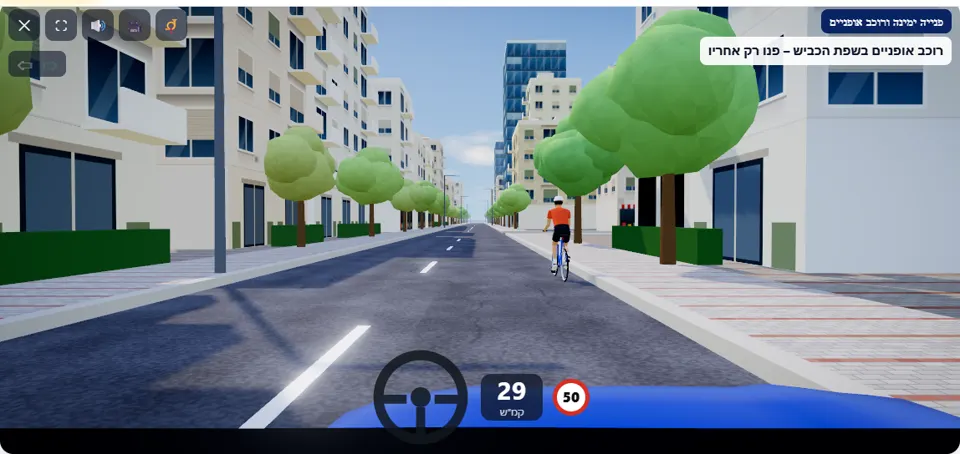
At the intersection ahead you are turning right, and ahead of you, at the edge of the road, is a cyclist who is going straight on. Signal right (E key or the signal button), check the right-hand mirror and the blind spot, and do not turn in front of the cyclist – let them pass the intersection. Turn only after them: a sharp turn, close to the right-hand edge of the road. In the turn itself the steering wheel turns by itself.
A city street, and further on an intersection where a side street joins from the right; before the intersection stands sign 115. You are turning right into the side street. Ahead of you, right by the edge of the road, rides a cyclist who is going straight on.
As long as you are far away, the simulator adjusts the cyclist’s pace so that a driver who carries on as usual reaches the intersection exactly alongside them. That is the trap: whoever turns right at that moment cuts across the cyclist’s path. Whoever slows down, stays behind and lets the cyclist pass the mouth of the side street – turns safely. The turn itself, sharp and close to the edge, is steered automatically.
How to pass the scenario
- Signal right with E (or ⇨ on a phone) early, even before you slow down for the turn. A signal turned on only in the last few metres gets a warning.
- Reduce your speed and stay behind the cyclist. Whoever overtakes the cyclist just before the intersection gets a tip that the cyclist is now on their right.
- Wait for the cyclist to pass the mouth of the side street. Whoever starts to turn when the cyclist is less than two car lengths ahead gets a warning.
- Turn slowly – above 25 km/h at the start of the turn the warning “Slow down before the turn” appears (a game threshold).
Mistakes that fail you
Each of these mistakes ends the drive at once, with the message quoted next to it:
- Starting to turn without the right signal on. The simulator: “You turned right without signalling – signal before every turn.”
- Starting to turn when the cyclist is alongside you, or less than a car length ahead of you, and has not yet passed the mouth of the street. The simulator: “You turned right while the cyclist was riding alongside you – turn right only when no vehicle is moving on your right, and a bicycle is a vehicle too.”
- Hitting the cyclist. The simulator: “You hit the cyclist.”
Three possible warnings: a cyclist too close ahead of you at the start of the turn (“The cyclist was too close ahead of you – wait until they are past the intersection”), signalling late and turning too fast. The tip about overtaking the cyclist before the intersection does not cost a star.
The speeds, distances and seconds the simulator checks are game thresholds, not numbers from the law – unless they appear in the rule itself.
Keys and buttons in this scenario
The E key or the ⇨ button turns on the right signal, and it switches off by itself after the turn. Up to the intersection you drive as usual; in the turn itself steering is automatic, and you control the speed.
In all scenarios: on a computer – arrows or WASD to accelerate and steer, and Space to brake; on a phone – accelerator, brake and steering buttons on the screen. The C key or the 🎥 button switches between the driver’s seat and a view from behind the car, the B key or the 📯 button sounds the horn, and the 🔊 button mutes the sound.
The official theory questions on this situation
The scenario is built on 4 questions from the official Ministry of Transport bank. Each question has its own page, with all the answers:
- 109 What should you check before beginning to make a right-turn?
Correct answer: That there is no vehicle driving on my right.
- 879
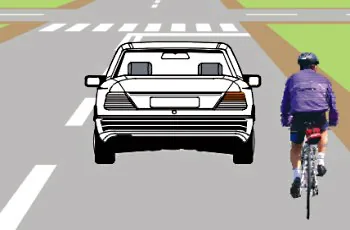 What should a driver do when he intends to turn right?
Correct answer: Take into account the chance that there will be a cyclist to his right during the turn, and take measures to avoid hitting him.
- 725
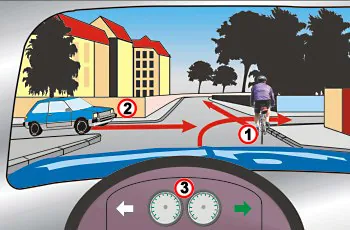 How should you (vehicle no. 3) behave while you turn right in the following intersection?
Correct answer: Allow the cyclist to continue riding and turn right behind him.
- 782 What risk is a driver facing while making a right turn?
Correct answer: Two-wheelers might enter the gap to his right during the turn.
Where to go next
- Drive the “Right turn and a cyclist” scenario in the simulator (opens for PRO users)
- All 32 scenarios of the driving simulator
- Test yourself: mock theory exam in English
Related scenarios
Cyclist ahead of youPRO
Overtake with a wide side gap – or stay behind
To the scenario page →Turning leftPRO
Signal, move towards the centre of the road and give right of way to oncoming traffic
To the scenario page →Bus pulling out of a stopPRO
The bus signals left and starts to pull out
To the scenario page →FAQ about the “Right turn and a cyclist” scenario
What do you check before turning right?
A cyclist on my right – who goes first?
Is it allowed to overtake the cyclist before the intersection?
Sources: Traffic Regulations (Hebrew) · theory question bank on data.gov.il. The simulator is a tool for practising the rules only and does not replace driving lessons with a licensed instructor.