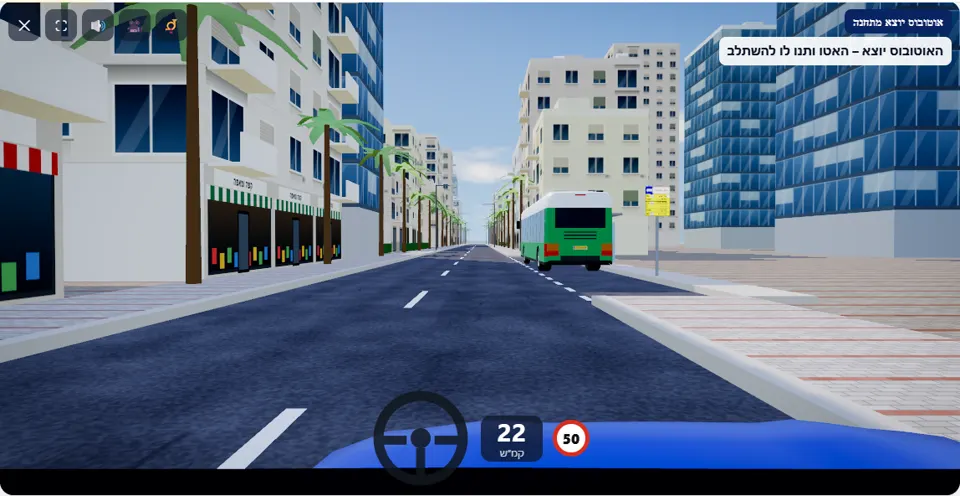
For PRO users it opens straight in the simulator. Not PRO yet? All about PRO, and meanwhile 9 scenarios are free for everyone. The PRO app interface is in Hebrew.
The mission
You are driving in town, and ahead of you a bus is standing at a stop. When it signals left and starts to pull out – slow down and let it merge in front of you, and then follow it, keeping a gap.
On the right of the street there is a bus bay, and a bus is standing in it. As you approach, the message “🚌 The bus is signalling and pulling out of the stop!” appears: its indicators flash, and a moment later it starts moving and enters your lane at an angle. Then it carries on in front of you, a little below the speed limit.
The temptation is to get past before it pulls out, or to overtake it on the left while it merges. Both options fail: from the moment the bus signalled, the simulator expects you to stay behind it.
How to pass the scenario
- Slow down as soon as you see a bus at the stop. Above 40 km/h near it (a game threshold) you get the warning “Slow down – the bus may pull out”.
- Seen it signalling? Brake and leave it room to pull out, and stop if necessary.
- Do not move out to the left to get past it: traffic is coming towards you.
- Once it is in the lane, follow it at its pace, more than one second behind. The gap meter appears in the corner of the screen after it has merged.
Mistakes that fail you
Each of these mistakes ends the drive at once, with the message quoted next to it:
- Driving on and passing it while it signals or pulls out. The simulator: “You overtook the bus as it pulled out of the stop – when a vehicle in front of you signals, let it do what it signalled.”
- Not slowing down and hitting it. The simulator: “You collided with the bus pulling out of the stop – when it signals, slow down and let it pull out.”
- Moving out to the left to overtake. The simulator: “You drifted into the opposite lane.”
- Moving right near the stop. The simulator: “You drove into the bus bay.”
A driver who slowed down in time and stayed behind finishes without warnings. The two possible warnings are for a high speed near a bus that is still standing, and for driving close behind it after it has merged (“Keep at least one second from the bus”).
The speeds, distances and seconds the simulator checks are game thresholds, not numbers from the law – unless they appear in the rule itself.
Keys and buttons in this scenario
Only accelerator and brake. No steering is needed – you stay in your lane throughout the scenario.
In all scenarios: on a computer – arrows or WASD to accelerate and steer, and Space to brake; on a phone – accelerator, brake and steering buttons on the screen. The C key or the 🎥 button switches between the driver’s seat and a view from behind the car, the B key or the 📯 button sounds the horn, and the 🔊 button mutes the sound.
The official theory questions on this situation
The scenario is built on 3 questions from the official Ministry of Transport bank. Each question has its own page, with all the answers:
- 169 What should we do when driving behind a vehicle that is giving a direction indicator signal?
Correct answer: We should allow the driver of the vehicle in front to perform the action he signaled for, by slowing down and stop if required.
- 969
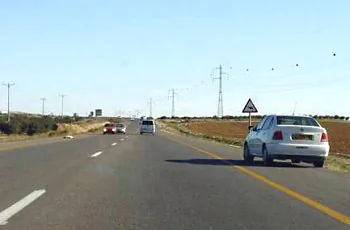 The white vehicle’s driver is merging into traffic. how would you behave?
Correct answer: Slow down
- 968
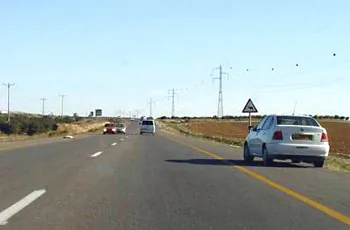 How would you conduct yourself when approaching a vehicle standing on the “hard shoulder”?
Correct answer: Slow down.
Where to go next
- Drive the “Bus pulling out of a stop” scenario in the simulator (opens for PRO users)
- All 32 scenarios of the driving simulator
- Test yourself: mock theory exam in English
Related scenarios
FAQ about the “Bus pulling out of a stop” scenario
Do you have to let the bus pull out of the stop?
When does the bus start to pull out?
What do you do after it has merged?
Sources: Traffic Regulations (Hebrew) · theory question bank on data.gov.il. The simulator is a tool for practising the rules only and does not replace driving lessons with a licensed instructor.