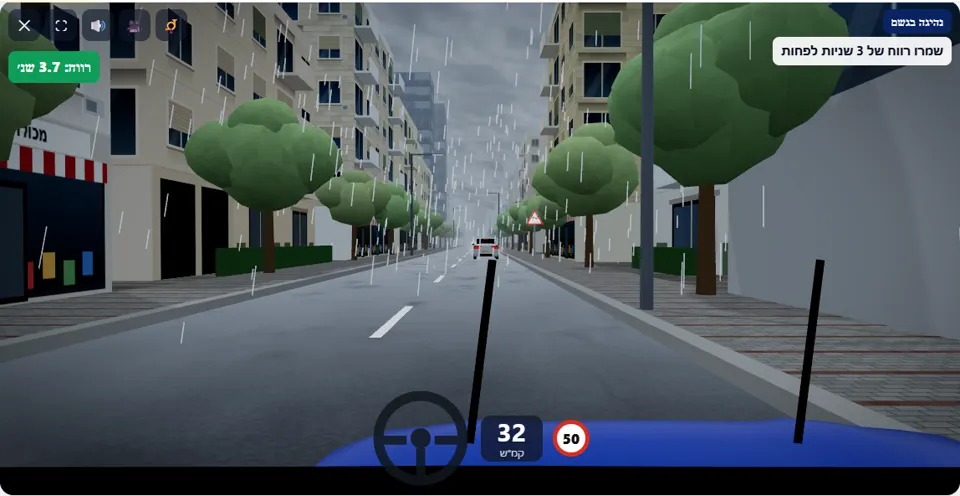
For PRO users it opens straight in the simulator. Not PRO yet? All about PRO, and meanwhile 9 scenarios are free for everyone. The PRO app interface is in Hebrew.
The mission
It is raining and the road is wet. Follow the car in front of you and keep a bigger gap than usual – on a wet road the car needs more metres to stop.
The same street and the same car in front of you as in the following distance scenario – but it is raining, the wipers are working and the road is wet. In the simulator the brakes are weaker on a wet road: the same press on the brake stops the car over a longer distance, and acceleration is slower too.
So the target on the gap meter rises from 2 to 3 seconds, and the fail comes already below one and a half seconds (game thresholds). The car in front drives more slowly than in the dry scenario and brakes twice during the drive. A driver who reacts only when the distance is already short finds that the brake is not enough.
How to pass the scenario
- Open a big gap right at the start, until the meter shows 3 seconds or more.
- Drive more slowly than usual: above 42 km/h (a game threshold) you get the warning “In the rain, slow down – the road is slippery”.
- Brake early and gradually the moment the brake lights in front of you come on.
- After each braking, wait for the gap to open again before you speed up.
Mistakes that fail you
Each of these mistakes ends the drive at once, with the message quoted next to it:
- Driving too close to the car in front for more than a moment. The simulator: “On a wet road you drove too close to the car in front.”
- Not managing to stop when it brakes. The simulator: “You crashed into the car in front – there was no gap left to stop.”
Two warnings lie in wait here: a gap of less than 3 seconds, and a speed too high for a wet road. Both can appear even when you are driving below 50 km/h – in this scenario even a permitted speed can be too fast.
The speeds, distances and seconds the simulator checks are game thresholds, not numbers from the law – unless they appear in the rule itself.
Keys and buttons in this scenario
Accelerator and brake only – the wipers work by themselves. The gap meter appears in the corner of the screen.
In all scenarios: on a computer – arrows or WASD to accelerate and steer, and Space to brake; on a phone – accelerator, brake and steering buttons on the screen. The C key or the 🎥 button switches between the driver’s seat and a view from behind the car, the B key or the 📯 button sounds the horn, and the 🔊 button mutes the sound.
The official theory questions on this situation
The scenario is built on 3 questions from the official Ministry of Transport bank. Each question has its own page, with all the answers:
- 611 Driving on a wet road creates:
Correct answer: A danger of skidding and turning-over, as speed increases
- 774
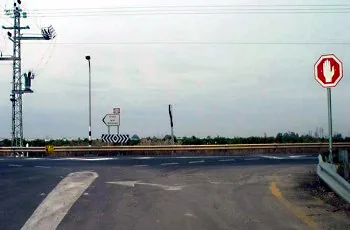 What is the main risk of approaching an intersection on a wet road?
Correct answer: The vehicle might skid into the area of the intersection due to the wet road.
- 671 The danger of skidding on a wet road is greater:
Correct answer: The more worn-out are the tires.
Where to go next
- Drive the “Driving in the rain” scenario in the simulator (opens for PRO users)
- All 32 scenarios of the driving simulator
- Test yourself: mock theory exam in English
Related scenarios
FAQ about the “Driving in the rain” scenario
How is the rain scenario different from the following distance scenario?
Why 3 seconds?
Can you skid in the simulator?
Sources: Traffic Regulations (Hebrew) · theory question bank on data.gov.il. The simulator is a tool for practising the rules only and does not replace driving lessons with a licensed instructor.